Why this short matters
The dramatic idea is a disturbing imbalance between composure and consequence. Ritual, ceremonial order and an unhurried speaker establish certainty; the film then sets that poise against overwhelming destructive force. Its recurring figures and progression into catastrophe make this an authored short rather than an isolated spectacle test.
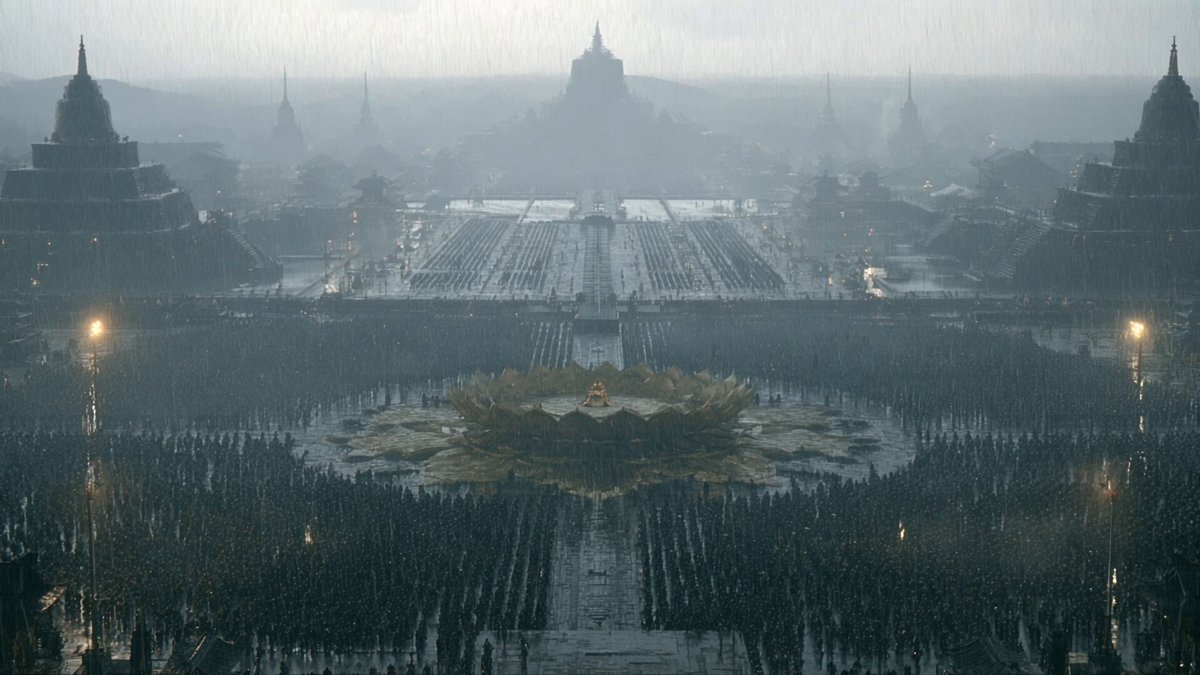
The original artwork gives the visual problem a concrete shape: crowds and temple towers recede around a lotus-like platform, turning an individual figure into a measure of a much larger institution. Sampled playback moves from a close speaking face to a bridge engulfed by a wave. The maker’s account of keeping familiar things in the foreground explains how such impossible scale is anchored for the viewer.
The language and religious imagery need precise attribution. The creator describes an invented Himalayan people, liturgical Pali and inspiration from Buddhist art. These choices establish a fictional world; the catalogue does not treat the characters as a representation of a real Buddhist community or claim independent verification of the spoken Pali’s accuracy.
The complete original player, release text, creator replies, sampled scenes and real video artwork were checked. This is a sourced introduction, not a full critical review. Venice is the disclosed platform; exact underlying models and uncredited collaborators remain unknown.
November 2 — an identified visual starting point
In a new disclosure, the maker points to an October 23 image of spacecraft firing onto a burning city as the painting that inspired the film. It gives the aerial destruction a concrete visual antecedent alongside the earlier accounts of scale and ceremonial calm. The painting’s artist and formal title are not identified in the checked source; the image is linked rather than reproduced as film artwork.